


Qamomile v0.9.0#
This release significantly expands Qamomile’s optimization capabilities by introducing support for Higher-order Unconstrained Binary Optimization (HUBO) problems through the new HigherIsingModel class (#219). Building on this foundation, QAOA can now handle HUBO problems using phase-gadget techniques (#221), enabling quantum algorithms to solve a broader class of optimization problems beyond traditional QUBO formulations.
We have also added comprehensive CUDA-Q tutorials. Please have a look at our releases and individual PRs for more details.
✨ New Features#
Introduce HigherIsingModel (#219 and #225)#
The HigherIsingModel class brings support for Higher-order Unconstrained Binary Optimization (HUBO) problems to Qamomile. While traditional QUBO problems are limited to quadratic terms, HUBO problems can include interactions of arbitrary order (e.g., cubic, quartic, or higher), making them applicable to a wider range of optimization scenarios.
Key features of HigherIsingModel:
Arbitrary Order Terms: Supports Ising models with terms of any degree, not just linear and quadratic
Unified Interface: The existing
IsingModelclass is now a subclass ofHigherIsingModel, providing backward compatibility while extending functionalityAutomatic Index Management: Handles index mapping and re-indexing internally, converting user-provided indices to zero-origin continuous indices for efficient quantum algorithm execution
The mathematical formulation of a higher-order Ising model:
where \(s_i \in \{-1, +1\}\) and \(w\) represents interaction strengths.
from qamomile.core.ising_qubo import IsingModel
from qamomile.core.higher_ising_model import HigherIsingModel

# Create a HigherIsingModel with cubic terms
higher_coefficients = {
    (0, 2): -1.5,        # Quadratic term
    (1, 2): 0.5,         # Quadratic term
    (0, 1, 2): 2.0,      # Cubic term (higher-order!)
    (0,): -2.0,          # Linear term
}
constant = 1.0
higher_ising_model = HigherIsingModel(higher_coefficients, constant=constant)

print("HigherIsingModel with cubic terms:")
print(f"Coefficients: {higher_ising_model.coefficients}")
print(f"Constant: {higher_ising_model.constant}")
print(f"Number of variables: {higher_ising_model.num_bits}")

# IsingModel is now a subclass of HigherIsingModel, providing backward compatibility
quadratic_coefficients = {(0, 1): -0.5}
linear_coefficients = {0: -1.0, 1: 2.0}
ising_model = IsingModel(linear=linear_coefficients, quad=quadratic_coefficients, constant=1.0)

print("\nIsingModel (subclass of HigherIsingModel):")
print(f"Has coefficients attribute: {hasattr(ising_model, 'coefficients')}")
print(f"Coefficients: {ising_model.coefficients}")
print(f"Linear: {ising_model.linear}")
print(f"Quadratic: {ising_model.quad}")
HigherIsingModel with cubic terms:
Coefficients: {(0, 2): -1.5, (1, 2): 0.5, (0, 1, 2): 2.0, (0,): -2.0}
Constant: 1.0
Number of variables: 3

IsingModel (subclass of HigherIsingModel):
Has coefficients attribute: True
Coefficients: {(0, 1): -0.5, (0,): -1.0, (1,): 2.0}
Linear: {0: -1.0, 1: 2.0}
Quadratic: {(0, 1): -0.5}
Update QAOAConverter to handle HUBO problems (#221)#
Building on the HigherIsingModel foundation, QAOA can now solve HUBO problems through the use of phase-gadget techniques. Phase-gadgets are quantum circuit constructions that enable the efficient encoding of higher-order terms into quantum circuits suitable for QAOA execution.
What are Phase-Gadgets?
Phase-gadgets are specialized quantum circuits that implement multi-qubit controlled rotations. For a higher-order term like \(Z_i Z_j Z_k\), a phase-gadget circuit implements the corresponding phase rotation using CNOT gates and an RZ gate.
Key Updates:
Automatic HUBO Detection:
QAOAConverternow automatically detects whether a problem is QUBO or HUBOPhase-Gadget Integration: Higher-order terms are automatically converted to phase-gadget circuits
Seamless User Experience: The same
QAOAConverterAPI works for both QUBO and HUBO problems
Technical Details:
When ising_encode() is called on a HUBO instance, the converter:
Detects higher-order terms in the problem
Creates a
HigherIsingModelinstead of the traditionalIsingModelGenerates phase-gadget circuits for each higher-order term during the QAOA ansatz construction
Combines these with standard QAOA mixer and problem layers
import jijmodeling as jm

from qamomile.core.converters.qaoa import QAOAConverter
from qamomile.core.circuit.drawer import plot_quantum_circuit

# Define a simple HUBO problem using JijModeling
# This example creates a problem with an N-body problem.
N = jm.Placeholder('N')
x = jm.BinaryVar('x',shape=(N,))
i = jm.Element('i', belong_to=(0, N))
problem = jm.Problem('N-body problem')
problem += jm.prod(i, x[i])
problem += jm.sum(i, x[i])

# Compile to OMMX instance
instance_data = {"N": 4}
interpreter = jm.Interpreter(instance_data)
instance= interpreter.eval_problem(problem)

# Convert to QAOA - now supports HUBO!
qaoa_converter = QAOAConverter(instance)
qaoa_converter.ising_encode()  # Automatically detects HUBO and uses HigherIsingModel

print(f"Problem type: {'HUBO' if not qaoa_converter.is_qubo else 'QUBO'}")
print(f"Ising model type: {type(qaoa_converter.get_ising()).__name__}")
print(f"Supports HUBO: {qaoa_converter._hubo_support}")

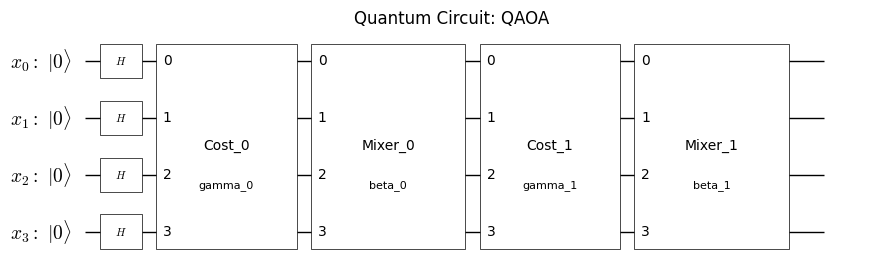
# Get QAOA circuit - phase-gadgets are automatically included in the cost layers
p = 2
qaoa_circuit = qaoa_converter.get_qaoa_ansatz(p=p)
plot_quantum_circuit(qaoa_circuit)
Problem type: HUBO
Ising model type: HigherIsingModel
Supports HUBO: True
🐛 Bug Fixes#
Fixed decoding errors (#225, #218): Resolved issues with bit-to-solution decoding in quantum converters, improving the accuracy of result interpretation
Index mapping improvements (#214): Enhanced index management in
HigherIsingModelto ensure correct mapping between problem variables and quantum bitsFixed Using the QuTiPTranspiler in Qamomile tutorial (#232): Resolved an issue in the QuTiPTranspiler tutorial, allowing users to execute the notebook
See our releases for more details.
🙏 Contributors#
We are grateful for contributions from the community! This release includes contributions from:
@Rafe-code - Fixed Using the QuTiPTranspiler in Qamomile tutorial (#232)
Thank you for helping make Qamomile better!
🛠️ Other Changes and Improvements#
CUDA-Q Tutorial (#212): Added comprehensive English and Japanese tutorials for using Qamomile with CUDA-Q, NVIDIA’s quantum computing platform. Check out the CUDA-Q usage tutorial to get started!
See our releases for more details.
💬 Feedback#
With the introduction of HUBO support through HigherIsingModel and phase-gadget techniques in QAOA, Qamomile v0.9.0 significantly expands the scope of optimization problems that can be tackled with quantum algorithms. This release makes Qamomile an even more powerful and versatile tool for quantum optimization research and development.
Whether you’re working on traditional QUBO problems or exploring higher-order optimization challenges, Qamomile provides a unified interface to access multiple quantum SDKs and compare results with classical solvers.
Try out Qamomile v0.9.0 today! Please submit any feedback or bug reports to GitHub Issues.